NRTidal convergence and common-data PE pilot
On 1 October 2026, IMRPhenomD_NRTidal and the IMRPhenomD control completed
restricted two-mass numerical PE baselines in Torch and JAX at 241 nodes per
chart coordinate. Independent quadrature also passed. This establishes numerical
integration and frontend agreement for these cases; it supplies no independent
physical injection, sampler validation or coverage claim. NRTidal's first mass
remains prior dominated and prior-support limited.
The original campaign remains unchanged: its NRTidal native rectangular grid was unresolved at 481 nodes per axis, with joint TV about 0.466. This pilot changes integration coordinates while retaining the original bounded posterior. Its separate protocol preserves the original campaign counts and failed receipts.
Frozen experiment
Both frontends consume the same retained original Torch data, PSDs, frequency bins and amplitude scale, verified against original receipt hashes. The experiment remains CPU FP64, zero noise, SNR 20, H1/L1 projection, two free component masses and every other parameter fixed.
| Case | Truth masses, solar masses | Independent uniform native prior bounds | Frequency grid | Fixed chart scale, solar masses |
|---|---|---|---|---|
| IMRPhenomD_NRTidal | 1.6, 1.3 | [1.59, 1.61] × [1.29, 1.31] | 30–512 Hz, df = 1 Hz | 1.5285226586348568e−5 |
| IMRPhenomD | 36, 29 | [33, 39] × [26, 32] | 20–400 Hz, df = 1 Hz | 0.031625357824682364 |
The chart uses native mass1 and a unit coordinate v. Its center c(mass1) follows the constant truth chirp-mass curve. For scale s and native mass2 bounds L, U, let a = asinh((L−c)/s) and b = asinh((U−c)/s). Then
This bijection covers the complete original rectangular prior, including exact endpoints. Quadrature integrates likelihood times J divided by the native prior area; the physical mode maximizes native likelihood. Native mass2 CDFs integrate partial chart cells at inverse-mapped cuts. Scale is fixed before integration from the median of five positive finite conditional curvature estimates, whose relative sigma spread must be at most 0.05. It is not fitted to the posterior.
The predeclared schedule is 31, 61, 121, 241, 481. Pilot protocol v1 retains the original numerical thresholds for joint TV, log normalizer, native quantiles, interval widths and mode drift. Native spacing becomes the maximum span across all four corners of every mapped chart cell, over the full prior. Additional requirements are:
- Two consecutive passing refinements in each frontend.
- At least four intervals across conditional-v 90% widths for rows within the native mass1 central 90% interval.
- Joint TV on factor-2 and factor-4 oversampled bilinear interpolants, with estimator drift at most 0.0025.
- Common-data likelihood agreement at every grid node (
atol=1e-7,rtol=1e-8) and posterior TV at most 1e-5 at every grid.
Retained design v2 binds final preflights and these gates before production integration; the earlier diagnostic design is retained. Design versions are distinct from the numerical protocol version.
Observed results
Final Torch refinement metrics are below; JAX also passes every gate. Runtime includes both frontends per model, excluding preflight and plotting.
| Case | Passing refinements | Joint TV | Absolute log-normalizer drift | Torch/JAX posterior TV | Grid runtime on len |
|---|---|---|---|---|---|
| IMRPhenomD_NRTidal | 61→121, 121→241 | 0.00168340 | 2.40e−6 | 1.69e−12 | 96.5 s |
| IMRPhenomD | 61→121, 121→241 | 0.00151991 | 7.73e−6 | 4.54e−12 | 79.8 s |
NRTidal's 31→61 refinement failed native mass2 resolution despite passing TV; that failure is retained. Maximum absolute Torch/JAX likelihood differences across all evaluated grids were 2.43e−9 for NRTidal and 1.00e−9 for PhenomD. Neither needed the scheduled 481 grid.
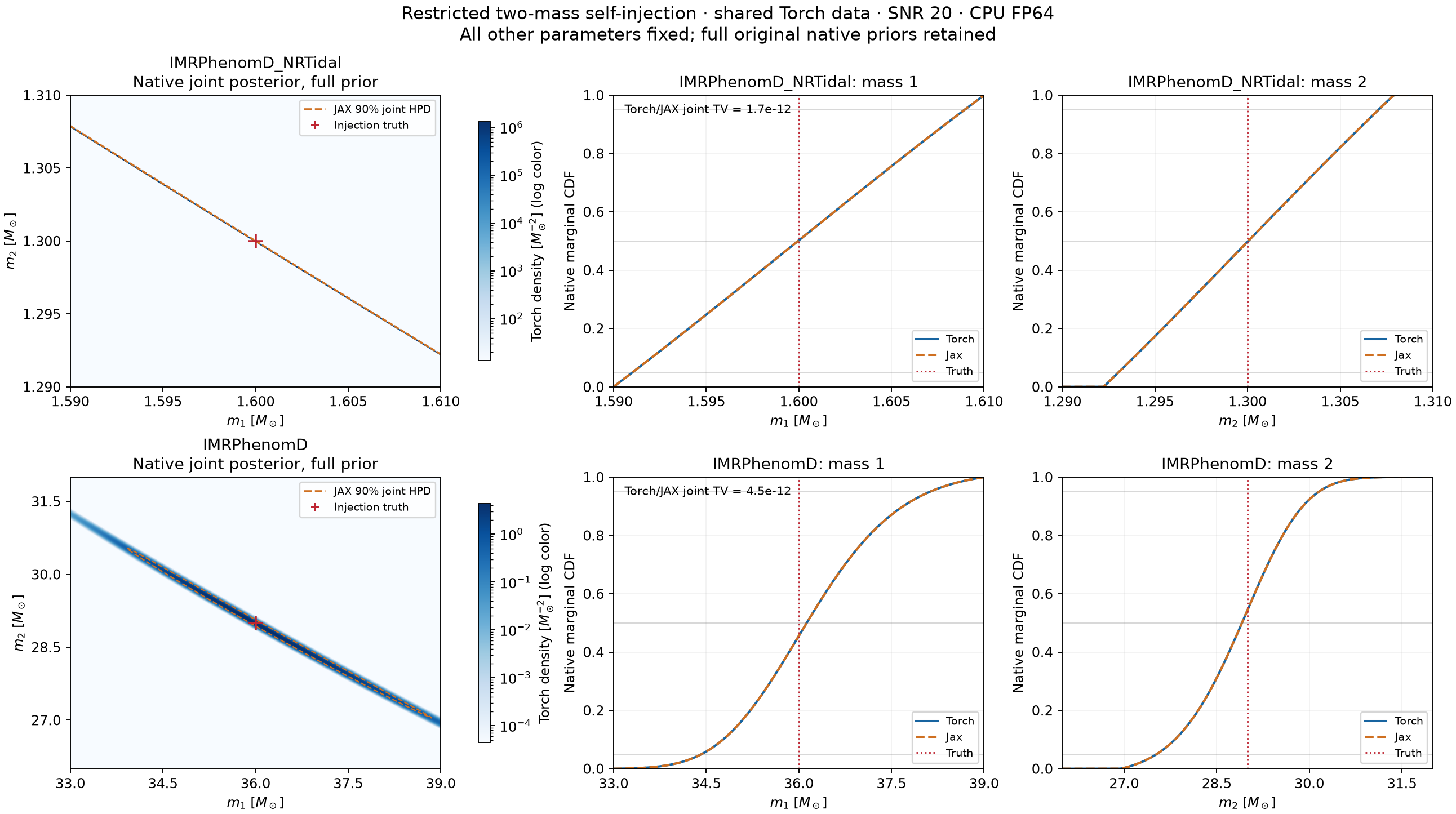
Full prior support is shown. NRTidal's narrow joint ridge coexists with broad marginals. Torch/JAX CDF overlays agree, while the nearly uniform mass1 CDF shows prior dominance. Native density includes the Jacobian conversion; color is logarithmic. The joint contour is a grid-based diagnostic.
Fresh full-support tensor Gauss-Legendre quadrature evaluates new native Torch likelihood nodes. Both cases pass at order 128 after comparison with order 64; order 256 was available if needed. The audit requires log-normalizer differences at most 0.05, native mean differences at most 5% of final 90% widths, relative standard-deviation differences at most 5%, density TV at most 0.05, and TV-estimator order drift at most 0.0025. It checks both agreement with the trapezoidal baseline and Gauss-order refinement.
| Case | Gauss/grid joint TV | Absolute log-normalizer difference | Largest relative standard-deviation difference | Audit runtime |
|---|---|---|---|---|
| IMRPhenomD_NRTidal | 0.00056385 | 7.99e−7 | 1.61e−5 | 5.8 s |
| IMRPhenomD | 0.00052139 | 2.58e−6 | 3.40e−6 | 3.0 s |
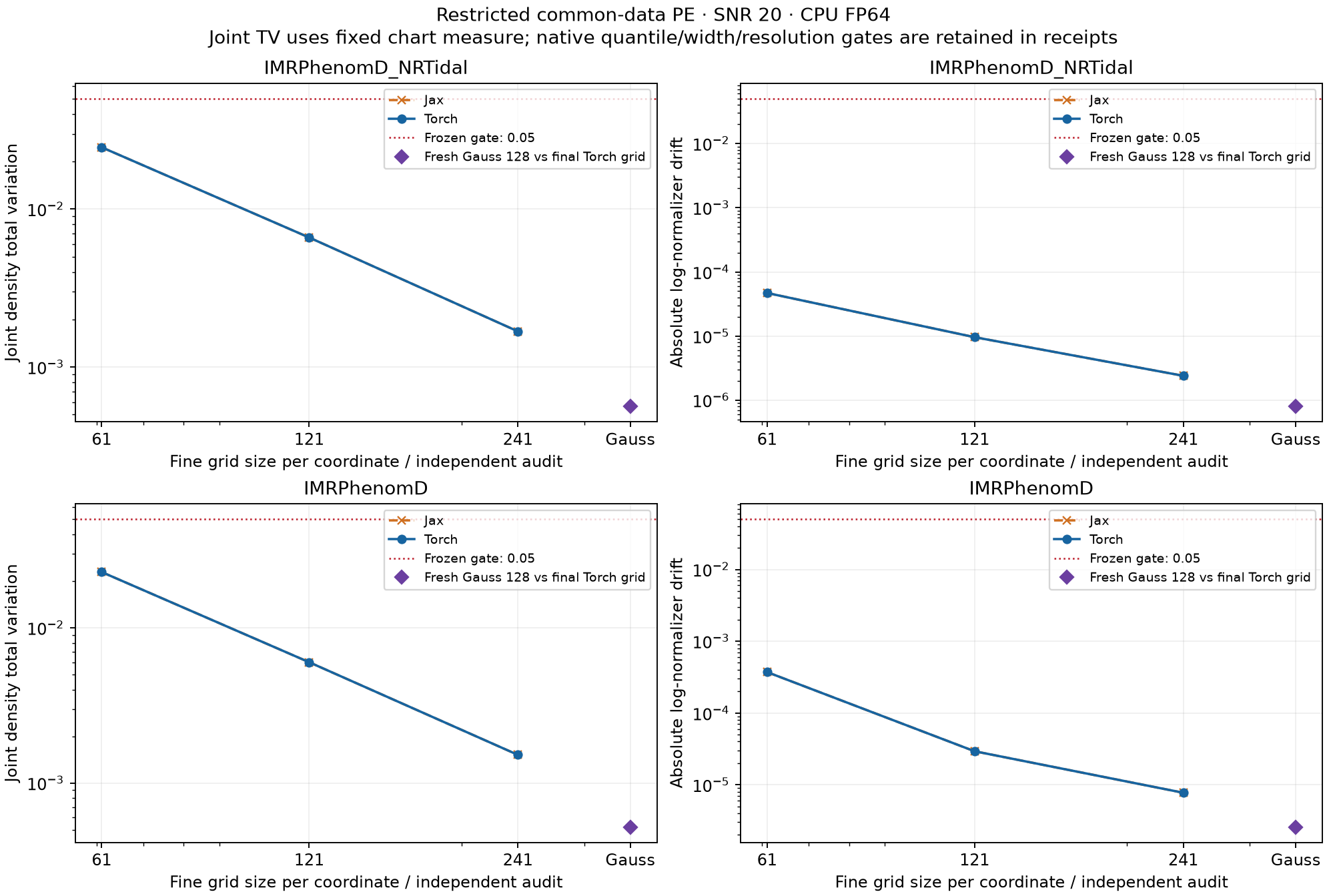
The Gauss point compares independent quadrature with the final grid; it is not another trapezoidal grid size. Every refinement and gate is retained in receipts. NRTidal mass1 marginal KL is 0.0002465 nats, below the declared 0.01 diagnostic; its outer prior-edge masses are about 4.85% and 4.75%. PhenomD mass1 is also prior-support limited, with about 1.18% in its upper outer 5% prior band. Convergence does not remove these limitations. Tides, spins and extrinsics were fixed. Physical qualification gates retain their existing outcomes.
Reproducibility
The machine-readable record contains
summaries, refinement/parity history, source/runtime binding and executor hashes.
The artifact bundle diffgw-pe-pilot-20261001 retains bulk arrays, full receipts
and the executed source snapshot. The record identifies these retained files by
hash; the bundle is not a public downloadable archive.
Executed archive source-pilot.tar.gz has SHA256
7d220096be0acb5836cf494bca9505c6cb71e1673f7fbd9dc31830e1a6d8cce9;
executed pilot runner SHA256 is
689f8cb23a068b422a3f60e7058ea3c3a77d4bb94ce93760277ccade97d95775.
These hashes identify the executed snapshot and runner.
The retained protocol and execution records bind the original data, chart scale, Python 3.12.3 environment, thread settings and CPU affinity (32–39). Optional JIT was not used. Waveform source bytes match the original campaign snapshot.
This baseline supports the separately frozen native Torch sampler check on the same bounded posterior. Broader parameter recovery and independent physical injections remain further experiments with their own numerical uncertainties.