Native Torch sampler validation
This 1 October 2026 experiment compares native Torch NUTS with the converged NRTidal/PhenomD quadrature baselines. It tests two free component masses in CPU FP64, zero-noise SNR-20 H1/L1 self-injections. Spins, tides and extrinsic parameters remain fixed. The same original data, PSDs, frequencies, amplitude scales and full rectangular native priors are retained. This experiment supplies no independent physical-accuracy, full-dimensional PE, noisy-coverage or JAX-sampler claim.
Target and preflight
The sampler uses the existing native dense detector-network Whittle likelihood; it introduces no compressed likelihood or waveform correction. The pilot's mass1/sinh conditional-mass2 chart covers the full original prior. The logistic function maps unconstrained logits to the open unit square. The log target includes the exact native uniform-prior density and both chart Jacobians. A fixed, differentiable Newton solve follows the positive chirp root.
Both cases pass eight preflight points: smooth/NumPy chart agreement, native Torch/JAX log-target and gradient agreement, finite-difference gradients, finite states, and compiled/eager Torch value/gradient agreement. Fresh native Torch likelihoods also reproduce seven nodes each from the retained 241 grid and independent order-128 Gauss quadrature. The largest absolute discrepancy is below 1e-7. Compilation is selected explicitly by the successful preflight; production does not silently switch execution strategies.
The native NUTS sampler uses momentum draws consistent with the supplied diagonal inverse mass matrix and the averaged adapted step size after warmup. Invalid proposals are rejected and recorded as divergences. Outer candidate selection and final-doubling adaptation follow Hoffman & Gelman's Algorithm 6.
Frozen sampler checks
Each case has four independently seeded chains: 10201, 20302, 30403 and 40504. Interior initial positions use truth logits plus independently seeded normal offsets; no reference posterior draws are fitted or used for initialization. The fixed diagonal metric uses prior-logit and truth conditional-curvature scales. Each run binds source/runtime, original data, reference arrays, preflight, seeds, metric, settings and gates in a SHA256-bound frozen protocol.
The following gates were fixed before the first production runs and remain unchanged in the separately frozen follow-up:
- Finite rank/folded R-hat below 1.01, and bulk/tail effective sample sizes at least 400, for both native masses, both chart logits, dense log likelihood and chirp mass.
- No retained divergences; at most 1% retained transitions stopped by the depth cap; finite transition diagnostics.
- Native mean discrepancy at most five actual mean Monte Carlo standard errors (MCSE) plus 0.5% of the reference 90% interval width. Mean MCSE must be at most 2% of that width.
- Native 5%, 50% and 95% quantile discrepancies at most 3% of the reference 90% width, with quantile MCSE at most 2% of that width.
- Six native CDF cutoffs and nine joint Rosenblatt cells: discrepancies at most five MCSE of the actual tested indicator plus 0.002 quadrature allowance; finite positive indicator MCSE at most 0.02. A zero-variance indicator fails.
The Rosenblatt map uses the retained grid's mass1 marginal and conditional mass2 CDF; its nine cells each have reference probability 1/9. This checks joint structure as well as marginal probabilities. The 0.002 allowance exceeds both cases' final refinement and independent Gauss/grid joint-density TV. No KDE bandwidth or sample/grid TV is used as an acceptance test. ArviZ 0.22.0 computes diagnostics on the actual tested functionals. Nonfinite statistics fail and remain explicit null values in JSON. Per-chain energy BFMI is reported with a 0.3 warning threshold, separately from the outcome gates. See the Stan diagnostic guidance and ArviZ ESS API.
Initial results and bounded follow-up
The first runs used 500 warmup and 1,000 retained draws per chain, target acceptance 0.8 and maximum depth 8. Both failed the original gates. Passing joint cells or near-reference estimates alone did not establish validation.
| Case | Largest rank/folded R-hat | Smallest bulk ESS | Smallest tail ESS | Retained divergences | Largest native median-CDF MCSE | Runtime on len |
|---|---|---|---|---|---|---|
| IMRPhenomD | 1.02650 | 212.4 | 504.0 | 3 | 0.02724 | 417.8 s |
| IMRPhenomD_NRTidal | 1.01033 | 248.7 | 593.4 | 2 | 0.02787 | 457.7 s |
Both cases had zero depth-cap terminations, finite diagnostics, no BFMI warnings and passing checks for all nine joint cells. Native-mass median probabilities failed their MCSE ceiling; several mean/quantile checks also failed precision or discrepancy limits. Correlated chart coordinates and occasional divergent transitions motivate a single bounded follow-up, without changing the target. Saved positions around divergences are accepted states; they do not identify the rejected leapfrog endpoints or prove the cause of the divergence.
The separately frozen follow-up retains the source, seeds, chart, diagonal metric, reference distribution and gates. It uses 1,000 warmup and 4,000 retained draws per chain, target acceptance 0.95 and depth 8. It evaluates all gates at the fixed endpoint, retains the failed initial results, and pools no initial draws. Each case has a 30-minute execution cap and no automatic extension.
Both follow-up runs pass every frozen gate at the fixed endpoint, using only their own 16,000 retained draws per case:
| Case | Largest rank/folded R-hat | Smallest bulk ESS | Smallest tail ESS | Retained divergences | Largest indicator MCSE | Runtime on len |
|---|---|---|---|---|---|---|
| IMRPhenomD | 1.00404 | 870.1 | 1,868.2 | 0 | 0.01383 | 1,003.3 s |
| IMRPhenomD_NRTidal | 1.00464 | 1,107.3 | 2,254.0 | 0 | 0.01320 | 1,184.2 s |
Both have zero retained depth-cap terminations and no BFMI warnings. Warmup has two and three divergences respectively, reported separately from the retained samples. All six native CDF cutoffs and nine joint cells pass for each case. The largest native quantile discrepancy is 0.55% of the reference 90% width for PhenomD and 1.86% for NRTidal, below the fixed 3% limit. Mean and quantile precision checks also pass.
The first recorded transitions took 163.3 s and 171.7 s, including startup, compilation and step-size initialization; those costs are included above. The subsequent transitions completed steadily. Each model finished within its 30-minute cap, in 16.7 and 19.7 minutes respectively.
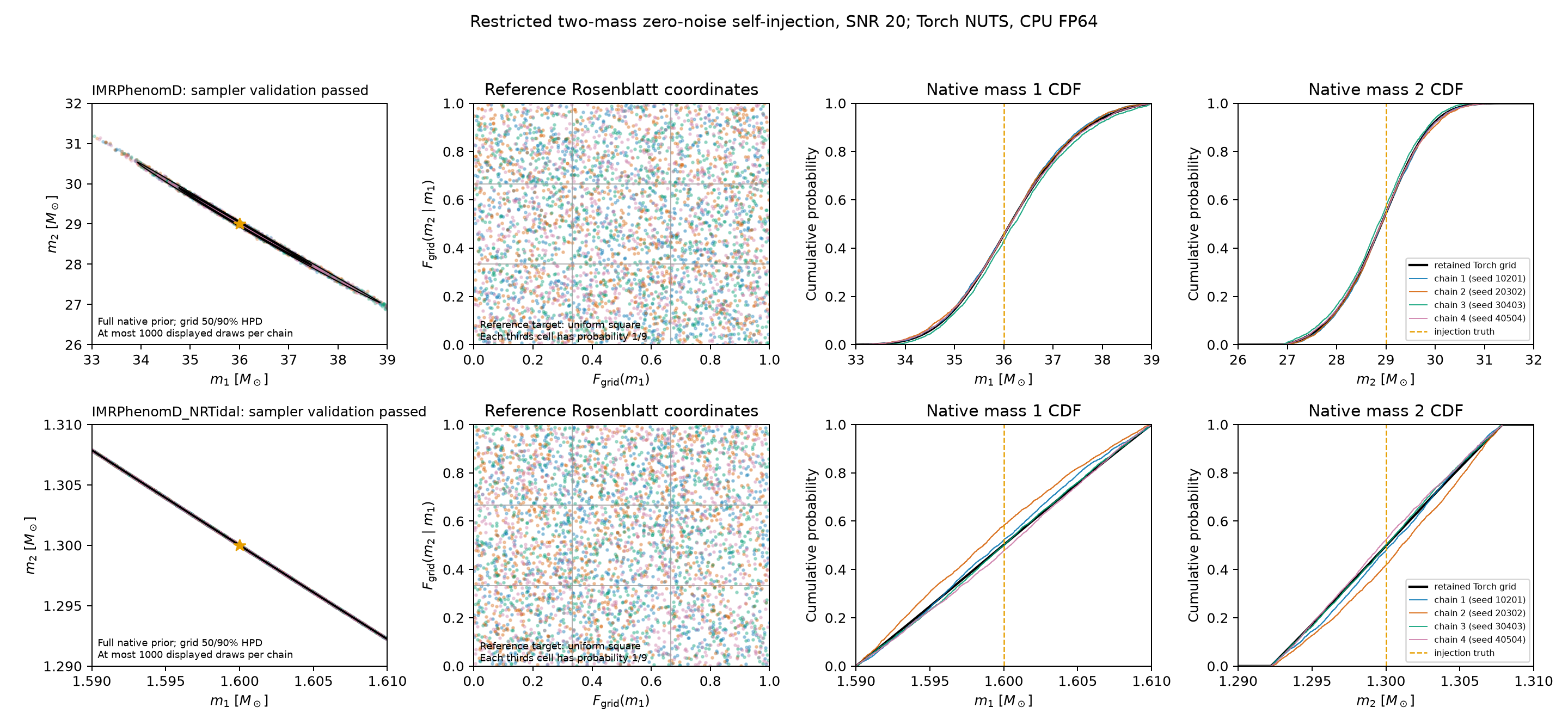
Native sample scatter and grid 50%/90% highest-density contours use the full original prior axes. Chainwise native CDFs use all retained draws. The joint Rosenblatt panels show the frozen equal-probability cells.
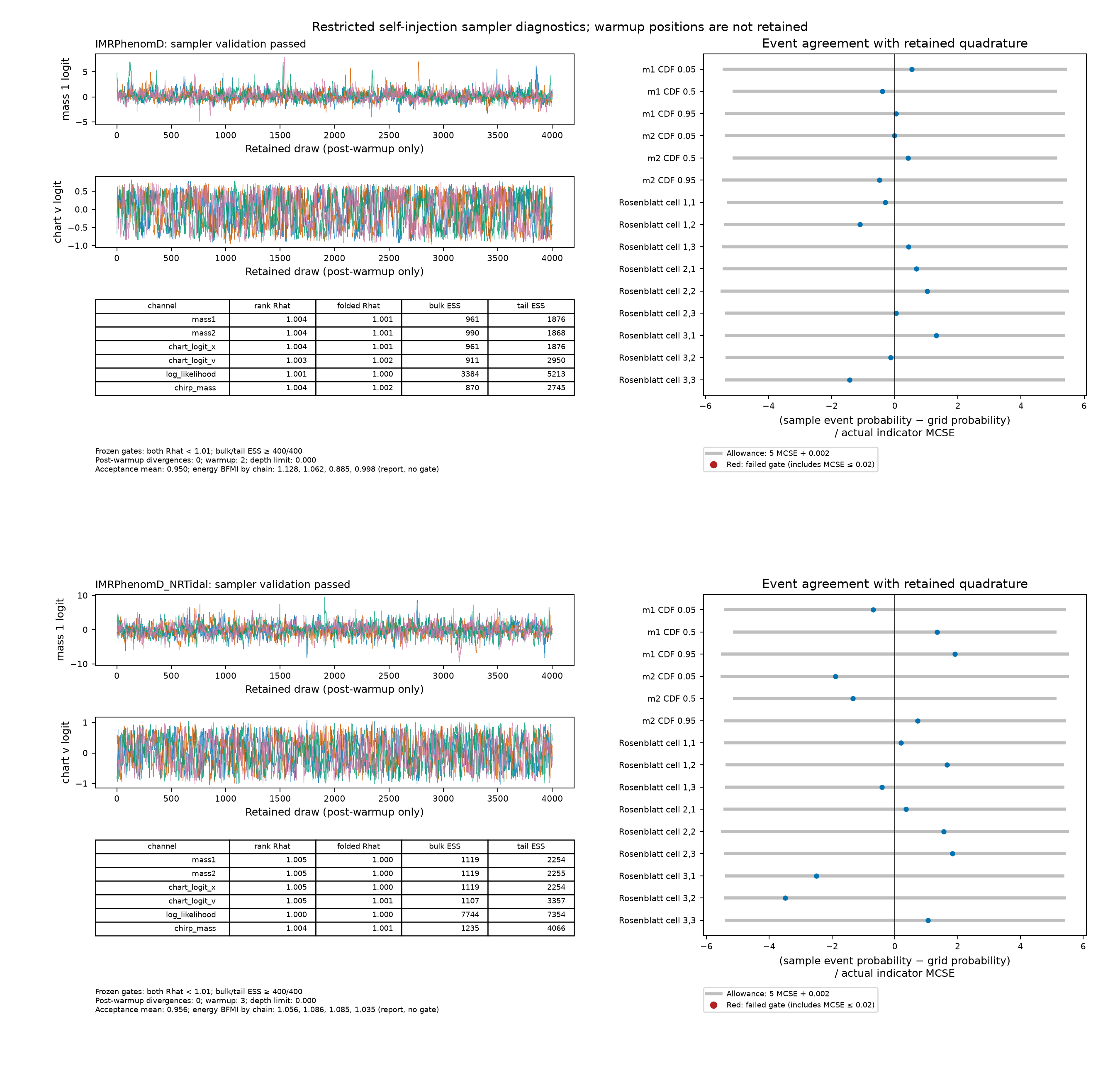
Trace plots show retained logits for all four chains. The table reports all six mixing channels; event residuals use each tested indicator's actual MCSE. Grey bars show the frozen five-MCSE-plus-quadrature allowance. The separately reported MCSE ceiling also contributes to each event's pass/fail outcome.
The compact experiment receipt records exact outcomes, failed initial results, frozen settings, artifact hashes and reproduction evidence.
Reproducibility
The artifact bundle diffgw-pe-sampler-20261001 retains chains, frozen protocols,
execution receipts and source snapshots. The linked compact receipt records
their hashes and binds the original data, quadrature references and sampler
settings. The bundle is retained evidence, not a public downloadable archive.
Executed source-sampler-v3.tar.gz has SHA256
fe1d37c7bde63815a4431063d06876435d939b1c8afddd18e7ed541a572b99b1.
Runtime: Python 3.12.3, Torch 2.14.0+cpu, JAX/jaxlib
0.11.2, NumPy 2.5.3, SciPy 1.18.1, ArviZ 0.22.0, float64/complex128 on len.
OMP, MKL and OpenBLAS each use one thread. CPU affinities are 32–35 and 36–39.
The retained frozen protocols identify the exact injection and quadrature arrays, initial positions, inverse mass, seeds and execution settings needed to reproduce the experiment.
Prior-dominated and prior-support-limited mass marginals remain limitations of these bounded experiments. Successful sampling in these two cases does not change waveform physical qualification gates or resolve the original campaign's separate numerical failures.